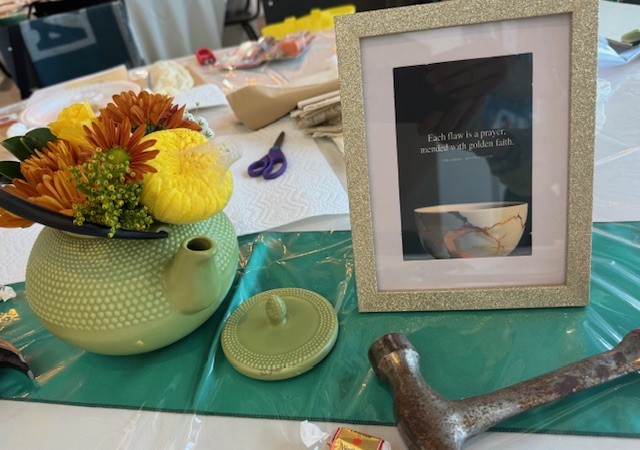
I was honored to recently attend an event with a close community who share strong faith and fellowship. The theme was “A Broken Masterpiece.” It was dreamed, organized, planned and executed by a woman who, like me, discovered meaning in the art of Kintsugi during her grief journey after suffering a devastating loss.
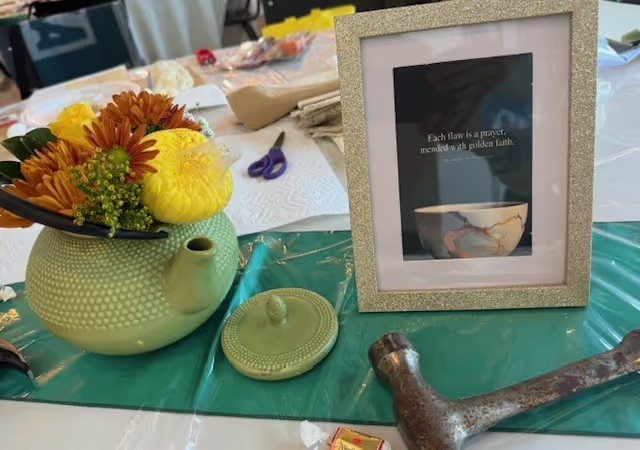
Kintsugi is a technique for repairing broken pottery with seams of gold. The word means “golden joinery” in Japanese. The repair is completed using a lacquer or resin that is sprinkled with powdered gold.
Part of the day included the chance to begin creating our own Kintsugi piece. We started by individually selecting a fully intact vessel from a table of beautiful offerings. I was drawn to a small green and white bowl. The first order of business was to break our vessel. Mine was stubborn, or my technique was bad. Either way, it took me about twelve swings of a hammer to get a crack.
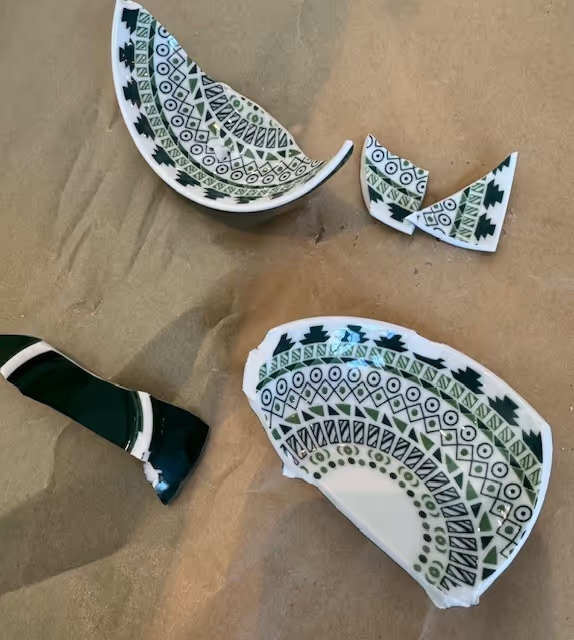
For me, the struggle to break was an interesting and unexpected twist. My previous personal reflection on Kintsugi, early in my grief journey, was the recognition that I was already broken and figuring out how to mend and heal. I had been cracked open by Tim’s death. And, as I grieved, other old wounds were surfacing because, how can they not. I was feeling it all. Many cracks. Most certainly feeling broken.
This is why I connected with Kintsugi. The goal is to not hide the scars and pretend that they never existed but to find renewed beauty as the broken pieces come together. Kintsugi gave me the perfect analogy for the work that lay before me and the hope of who I may become.
I have been mending the broken pieces. The scars from the loss of Tim have been formed and they are beautiful. They are no longer fresh, though occasionally a little tender. I’m not saying that I’m fully mended or healed, because honestly, what is that? I’m not sure I know. But this experience, the practice of intentionally breaking something that was seemingly in perfect condition, offered me a new reflection.
What about those times in our life where we intentionally break something because it’s the right thing to do? And maybe even because it is what we desire? It might be quitting a great job. Perhaps it is moving to a new place. It could be letting go of a habit or routine. Maybe it’s ending a perfectly healthy relationship.
How do we break something that is no longer serving our best life? This can be a hard thing to do. As I tapped that bowl with my hammer each time, I thought, “I don’t know if I can do this.” Maybe, I should stop. It’s too hard to break. Maybe it would be easier if I were angry or hurt and gave it a real pound! Or, maybe I should just play it safe and keep it just as it is.
It is not easy to break something intentionally. We may have to remind ourselves, with each tap of the hammer, we have our reasons for doing it. We have an opportunity to build something new. And honestly, at first glance, it might not look as nice as the original. If my attempt at Kintsugi is any indication, I can say that making that new, beautiful bowl, might not come easy. In fact, the process of this art of Kintsugi is not a quick repair. The resin must be layered with periods of drying, scraping, sanding and polishing in between.

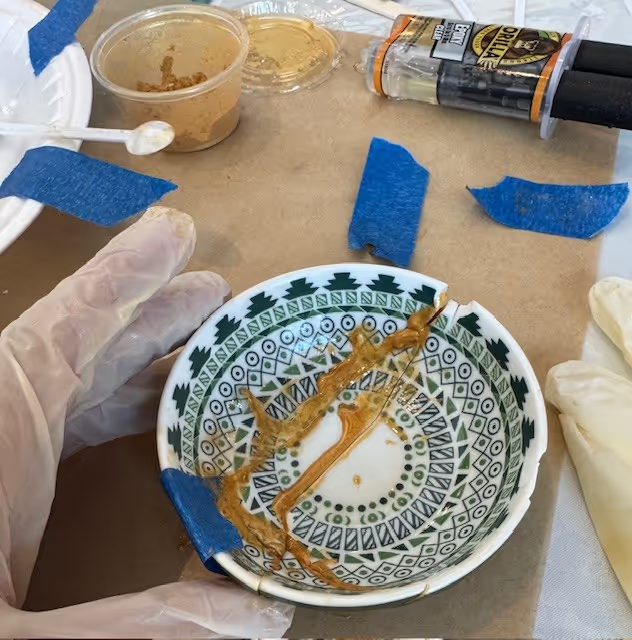
So, yes, I still have more work to do on my vessel. Change, whether we choose it or not, takes work. It can be hard to see the beauty at first. To receive the rewards from the discomfort. But give it a chance. The beauty will show itself with enough effort, intention, and love, and maybe a little bit of pounding and a sprinkle of gold dust.
Share this Post
Similar Posts
Remove the comma
Remove the comma
September 19, 2026
This week, I was part of a conversation with several women who were contemplating what it would be like to be living with Alzheimer’s.
This week, I was part of a conversation with several women who were contemplating what it would be like to be living with Alzheimer’s.
Make room for the comfies
Make room for the comfies
July 6, 2023
For fifteen years, I traveled several times a month for work. I loved it and missed it when it ended. There are skills you develop when you are living that life.
For fifteen years, I traveled several times a month for work. I loved it and missed it when it ended. There are skills you develop when you are living that life.

Grief is not a bad thing
Grief is not a bad thing
September 9, 2023
My blog has been live since March 2020. I’ve published 78 entries and have had 5,370 visitors and 10,705 views. When I started, I didn’t have a hard list of goals.
My blog has been live since March 2020. I’ve published 78 entries and have had 5,370 visitors and 10,705 views. When I started, I didn’t have a hard list of goals.
Subscribe with your email
Know when new posts are published.

Contact
I'd be honored to help you on your journey.
Prefer email? Reach me at info@loveyoumoredoula.com.